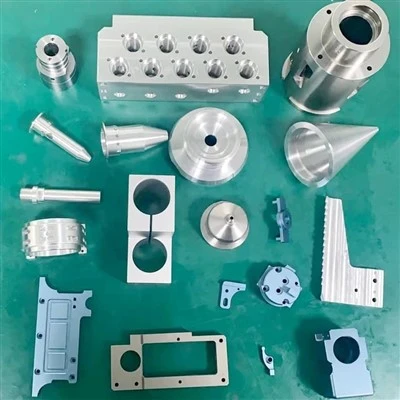
In modern manufacturing systems, parts are formed in various ways. CNC parts, due to their technical principles and process characteristics, differ significantly from casting, forging, stamping, and traditional machining parts. A deep understanding of these differences helps in accurately matching requirements during the design and selection phases, fully leveraging the advantages of each manufacturing method.
Compared to cast parts, the biggest difference in CNC parts lies in their forming mechanism and precision control. Casting relies on molten metal cooling and solidifying in a mold cavity to obtain shape. While suitable for complex, large-volume parts and capable of forming multiple parts at once, it is prone to problems such as shrinkage cavities, porosity, and surface roughness. Dimensional accuracy is typically limited to the millimeter level, requiring extensive subsequent machining for finishing. CNC parts, on the other hand, are directly machined from solid materials, allowing for precise control of micron-level tolerances. Surface quality and dimensional accuracy are far superior to castings, and no mold investment is required, making them suitable for small-batch, multi-variety, and high-precision applications.
Compared to forged parts, there are significant differences in material properties and structural complexity. Forging uses external force to induce plastic deformation in metal blanks, refining grains and distributing fibrous structure along the direction of force, thus achieving high strength and toughness. It is often used for structural components such as shafts and connecting rods that bear heavy loads. However, forging cannot directly form intricate hole systems, complex curved surfaces, and composite features, requiring subsequent machining. While CNC parts do not have the same internal fibrous continuity as forged parts, they can achieve integrated forming of complex geometries with extremely high degrees of freedom, and have advantages in dimensional accuracy and surface finish.
Compared to stamped parts, CNC machining overcomes the limitations of sheet metal forming. Stamping relies on dies to plastically bend or stretch flat materials under pressure, resulting in high production efficiency and low cost, suitable for mass production of regular thin sheet metal parts. However, it is constrained by dies, making it difficult to process thick-walled, deep-cavity, or non-planar features, and corners are prone to springback and cracking. CNC parts are not limited by sheet thickness and shape, allowing for multi-faceted machining of blocks to achieve complex three-dimensional structures, and can flexibly respond to design changes.
Compared to traditional manual or template-based machining, CNC machining offers significant advantages in consistency and flexibility. Traditional machining is heavily influenced by operator skill and experience, leading to potential discrepancies between batches of parts. In contrast, CNC machining is program-driven, boasts high repeatability and positioning accuracy, maintains stable quality over extended periods, and allows for rapid switching between workpiece types by changing programs, accommodating multi-variety, small-batch production.
In summary, CNC machining distinguishes itself from other manufacturing methods in terms of forming accuracy, structural complexity, material adaptability, and production flexibility, making it a core option for high-precision, multi-functional, and rapid-response manufacturing needs.