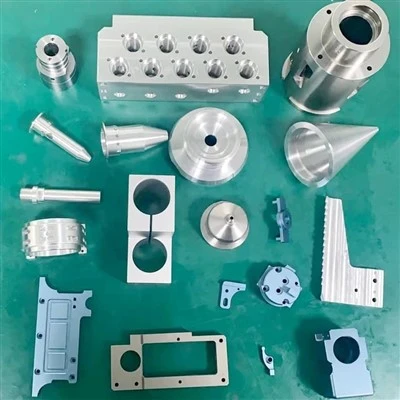
The performance of CNC parts is the core criterion for their effectiveness in harsh working conditions and high-precision scenarios, encompassing multiple dimensions such as dimensional accuracy, structural strength, surface quality, stability, and material compatibility. These properties are jointly determined by the technical characteristics of CNC machining and the level of process control, demonstrating significant advantages in high-end applications of modern industry.
Regarding dimensional accuracy, CNC parts, relying on digital programming and multi-axis linkage control, can achieve micron-level tolerances while maintaining batch consistency. Closed-loop feedback systems can correct toolpaths and cutting parameters in real time, ensuring high consistency of key mating surfaces, locating holes, and contour curves across different workpieces. This precision performance directly improves assembly efficiency and service reliability in fields with extremely stringent requirements, such as aero-engine blade contours, medical implant connection structures, and optical instrument brackets.
Structural strength and rigidity are another important performance indicator. By optimizing cutting strategies and path planning, CNC machining can create reasonable rib distribution, wall thickness gradients, and transition fillets in metal or engineering plastic parts, effectively dispersing stress concentration and enhancing fatigue and deformation resistance. Under high loads or alternating stresses, the precisely calculated and machined structural performance extends part lifespan and reduces failure rates.
Surface quality also reflects the performance advantages of CNC parts. High-speed precision cutting and scientific matching of tool geometry parameters result in a surface with low roughness and good gloss, reducing frictional loss and stress corrosion risk, and playing a crucial role in applications such as sealing, heat conduction, or optical reflection.
Stability is demonstrated in both long-term service and mass production. The solidification of CNC programs and machine tool status monitoring ensure high consistency in size and performance for parts in the same batch; while in long-term use, appropriate heat treatment and surface strengthening processes combined with CNC precision forming ensure that parts maintain their intended performance under the influence of environmental factors such as temperature fluctuations and media corrosion.
Material compatibility expands the scope of performance development. CNC machining is compatible with aluminum alloys, titanium alloys, stainless steel, and various engineering plastics and composite materials. The optimal material can be selected according to service conditions, and its strength, heat resistance, or lightweight potential can be unlocked through process adjustments.
Overall, CNC parts, with their comprehensive performance system consisting of precision, strength, surface quality, stability and material compatibility, have become an indispensable basic component of high-end equipment and precision systems, and continue to drive the manufacturing industry toward higher quality and higher reliability.