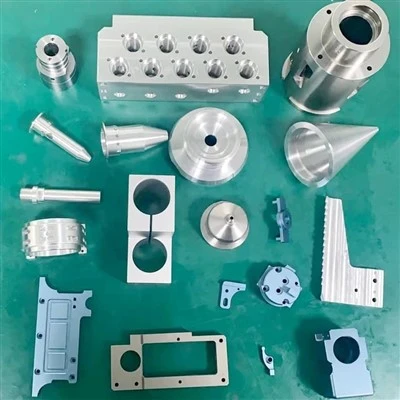
In contemporary high-end manufacturing, five-axis machining has become a key technology for achieving efficient forming of complex curved surfaces and high-precision parts. Its definition can be explained from two dimensions: machine tool structure and motion capability. Five-axis machining refers to a machining method where the machine tool can move along three linear coordinate axes (usually X, Y, and Z), supplemented by two rotary coordinate axes (such as A/C or B/C axes). This allows for the machining of multiple surfaces of a workpiece in a single setup, significantly improving machining freedom and geometric adaptability.
Compared to traditional three-axis machining, the biggest feature of five-axis machining is the introduction of rotary axes, enabling the tool or workpiece to tilt and rotate in multiple directions within space. This multi-axis linkage capability not only expands the reach of the tool and reduces interference between the tool and workpiece, but also maintains a constant cutting angle between the tool and the machined surface, improving cutting conditions, reducing tool wear, and enhancing surface quality. In machining features such as deep cavities, oblique holes, and complex impellers that are difficult to reach with three-axis machining, five-axis technology can achieve continuous and smooth toolpath planning through spatial attitude adjustment, avoiding the cumulative errors caused by multiple clamping operations.
From a machining principle perspective, five-axis machining uses a CNC system to synchronously control the displacement and rotation of five motion axes, ensuring that the tool path strictly follows a preset three-dimensional surface mathematical model. During this process, the control system needs to calculate the motion relationships of each axis in real time to ensure that the synthesized motion is highly consistent with the theoretical path. This not only places strict requirements on the dynamic response and geometric accuracy of the machine tool but also relies on advanced programming strategies and post-processing algorithms to fully leverage the advantages of multi-axis collaboration.
The definition of five-axis machining also embodies a dual pursuit of manufacturing efficiency and quality. The ability to complete multi-faceted machining in a single clamping operation significantly shortens the production cycle time, reduces the number of fixtures, and minimizes repetitive positioning errors. Simultaneously, optimized cutting attitude helps improve material removal rate and machining stability, making it particularly suitable for scenarios with extremely high requirements for shape complexity and dimensional accuracy, such as aerospace structural components, mold cavities, and precision medical implants.
In summary, five-axis machining is an advanced manufacturing mode that uses the linkage of three linear axes and two rotary axes to achieve efficient and high-precision machining of complex parts through flexible spatial posture adjustment and continuous path control. It not only reflects the advancement of machine tool technology but is also a core means for high-end manufacturing to meet the diversified and sophisticated production needs.